

Lyssna på den här podden kostnadsfritt i appen: Ladda ner gratis i App Store
radio.se
Sleeptimer
Spara kanal
230 avsnitt
Future of an Illusion
2026-10-11 | 1 h 11 min.On this episode, Ryan and Todd discuss Freud's Future of an Illusion, a text that would become overshadowed by his subsequent publication, Civilization and Its Discontents. The hosts discuss the relationship between the two texts--paying close attention to how the drive becomes figured and then reconfigured in the latter text--but are careful to stamp out where Illusion departs in focus and in substance from one Freud's most well-known works. The hosts also work through Freud’s thoughts on religion in Illusion and compare it against his later thoughts in Moses and Monotheism and more recent work on psychoanalysis and religion (specifically when compared to Rick Boothby’s Embracing the Void).Neo Noir
2026-09-27 | 1 h 18 min.On this episode, Ryan and Todd return to their film genre series to discuss the neo noir. As opposed to the classic noir period, which is named retroactively by French film critics (1941-1958), neo noir films were aware of how they fit into a specialized genre. Does this mean the Neo noir is more of a genre than the class noir? Less of one? Is it just a style? What unique affordances hold the genre together now that these films are made post-Code? This episode discusses these questions and more with extended reference to: The Long Goodbye, Body Heat, One False Move, and The Last Seduction among many other films.
Also referenced in this episode and available to watch on YouTube is Pretty PoisonDivine Violence
2026-09-13 | 1 h 10 min.On this episode, Ryan and Todd discuss the notion of divine violence. The conversation draws principally on an encounter staged between the term's evocation in Walter Benjamin's 1921 essay, "Toward a Critique of Violence" and the term's later deployment by Slavoj Žižek in his book On Violence. The conversation also touches on Giorgio Agamben's use of "bare life" (a phrase used, though translated slightly differently, by Benjamin in his essay) and how recent podcast conversations on Frantz Fanon overlap or depart from the concerns of divine violence.
The Vader SessionsWretched of the Earth
2026-08-30 | 1 h 12 min.On this episode, Ryan and Todd complete their Frantz Fanon duology by talking about his final completed work, Wretched of the Earth. The episode focuses on Fanon's "stretching" of both Marxism and psychoanalysis to ground his unique decolonial intervention.Black Skin, White Masks
2026-08-17 | 1 h 22 min.On this episode, Ryan and Todd discuss Frantz Fanon's decolonial classic, Black Skin, White Masks. The hosts work through the conversation surrounding his credentials as a psychoanalyst, his engagement with Freud, Lacan, Octave Mannoni, and Carl Jung, and his dialectical relationship with Jean-Paul Sartre's existentialism and his Marxism.
Fler podcasts i TV och film







Trendiga poddar i TV och film














Om Why Theory
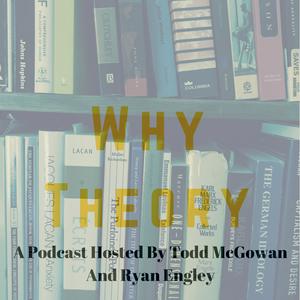
Why Theory brings continental philosophy and psychoanalytic theory together to examine cultural phenomena.
Podcast-webbplatsLyssna på Why Theory, The Big Picture och många andra poddar från världens alla hörn med radio.se-appen
Hämta den kostnadsfria radio.se-appen
- Bokmärk stationer och podcasts
- Strömma via Wi-Fi eller Bluetooth
- Stödjer Carplay & Android Auto
- Många andra appfunktioner
Hämta den kostnadsfria radio.se-appen
- Bokmärk stationer och podcasts
- Strömma via Wi-Fi eller Bluetooth
- Stödjer Carplay & Android Auto
- Många andra appfunktioner

Why Theory
Skanna koden,
ladda ner appen,
börja lyssna.
ladda ner appen,
börja lyssna.
Why Theory: Poddsändningar i Familj
 Sverige